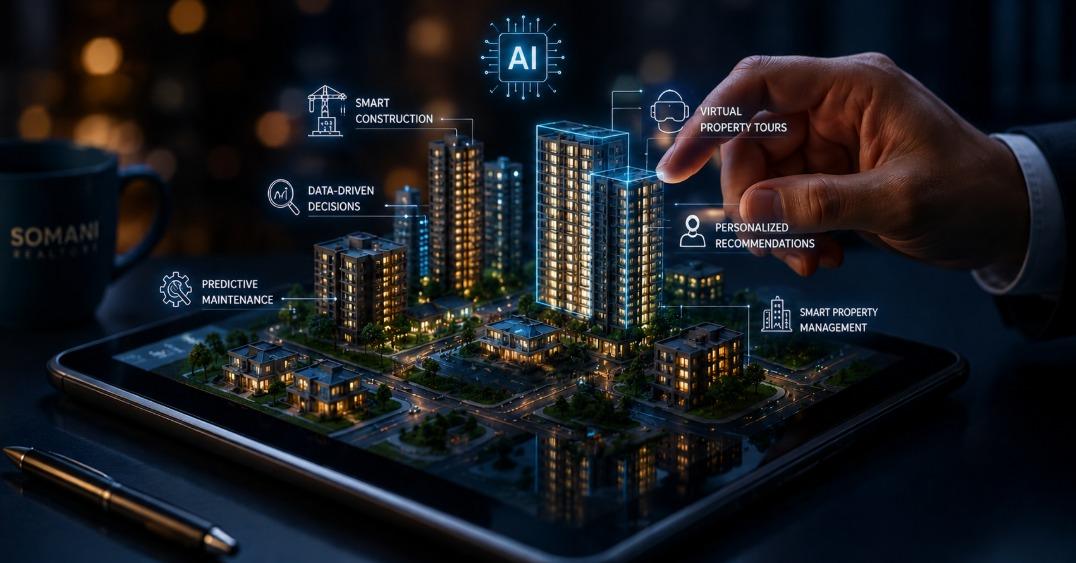
How AI is Changing the Way India Builds, Buys, and Manages Real Estate
28th May 2026
India’s real estate sector has always evolved alongside infrastructure, regulation, and economic growth. But in 2026, AI is reshaping the industry faster than any policy reform or market cycle ever could
What began as digital listing portals and CRM automation has now evolved into something far bigger. Today, AI in real estate is influencing everything—from identifying the right land parcel and forecasting construction demand to helping buyers discover properties, enabling predictive maintenance, and optimizing long-term asset performance.
Across residential, commercial, and mixed-use developments, artificial intelligence in real estate is no longer a futuristic experiment. It is rapidly becoming the operational backbone of India’s property ecosystem.
And perhaps the most important question is
Will AI change real estate?
The real question is:
How deeply will it redefine the way India builds, buys, and manages property over the next decade?
Recent industry reports from The Times of India, KPMG India, and leading proptech platforms suggest that AI is moving from tactical automation to strategic decision-making across the real estate lifecycle. Developers are increasingly using data-led systems for design optimization, pricing intelligence, construction efficiency, and smart building management.
This transformation deserves a closer look.
AI in Real Estate Development: Building Smarter Before Construction Even Begins
AI is changing that model completely.
Today, AI in real estate development allows developers to analyze:
- Population migration patterns: AI helps developers understand where people are moving for jobs, education, and lifestyle upgrades. This allows them to identify emerging residential hotspots before demand peaks.
- Infrastructure pipeline announcements: By analyzing upcoming metro lines, highways, airports, and smart city projects, AI can predict which areas are likely to witness rapid appreciation and development growth.
- Employment cluster expansion: AI tracks the growth of IT hubs, business parks, industrial zones, and commercial districts to estimate future housing demand near employment centers.
- Traffic and mobility data: Developers can use AI to study commute times, congestion patterns, and transport accessibility to plan projects in locations with better connectivity and livability.
- Historical transaction records: AI analyzes past sales trends, price movements, and transaction volumes to identify stable investment zones and forecast future market performance.
- Buyer behavior across micro-markets: AI studies; customer preferences, search trends, and buying patterns across different localities to help developers design projects that better match market demand.
Developers can now use AI to evaluate future growth potential and investment viability with far greater accuracy. Therefore,
Instead of asking:
"Will this location work?"
Developers can now ask:
"What does five years of data suggest about this location’s appreciation potential?"
AI-powered predictive models are helping developers identify emerging corridors before traditional demand becomes visible. In cities like Mumbai, Bengaluru, Hyderabad, and Kolkata, this could mean entering a market 2–3 years before the wider investment cycle.
The Shift from Manual Property Search to AI-Driven Decision Making
Buying property has traditionally been a time-consuming and often overwhelming process. Multiple site visits, endless follow-ups, irrelevant listings, and stacks of paperwork have long been part of the buyer’s journey. Finding the right property often meant spending weeks—or even months - sorting through options that did not truly match individual needs.
Today, AI in real estate is changing that experience completely. What was once manual, repetitive, and often frustrating is now becoming faster, smarter, and far more personalized.
Modern AI-powered platforms can understand how buyers search, analyze their preferences, and intelligent recommendation engines now deliver curated property options customised to specific user profiles. A working professional may receive recommendations near upcoming business districts and metro corridors, while a family buyer may see projects prioritized based on school connectivity, healthcare access, open spaces, and long-term livability.
Instead of scrolling through hundreds of listings, buyers are now increasingly presented with curated property options tailored to their budget, lifestyle, commute preferences, family requirements, and even long-term appreciation goals.
This shift represents one of the biggest milestones in digital transformation in real estate. The industry is steadily moving away from static listing-based discovery toward a far more dynamic and intent-driven ecosystem - where technology understands not just what buyers are searching for, but the deeper motivations behind those searches.
Instead of asking:
Which property should I look at next?
Buyers can now ask:
Which property matches my lifestyle patterns, commute behaviour, future family needs, investment goals, and probability of long-term value appreciation based on real-time market intelligence?
This is where AI-powered real estate platforms are transforming property discovery from a simple search process into a predictive decision-making experience. Proptech ecosystems like ANAROCK AI use machine learning, predictive analytics, and customer-intelligence models to understand not just what buyers are searching for, but the deeper behavioural patterns behind those searches.
Challenges India Still Needs to Solve
Despite rapid adoption, challenges remain:
Fragmented Data
Many property records remain inconsistent across markets.
Regulatory Variation
Approval systems differ from state to state.
Digital Maturity Gap
Not all developers are equally digitized.
Human Resistance
Traditional sales models are still deeply entrenched.
Ethical and Privacy Concerns
AI requires the responsible handling of buyer and transaction data.
These limitations are real.
Instead of asking:
Why is AI adoption difficult in Indian real estate?
The industry can now ask:
What technological, regulatory, and data-driven transformations are required to make AI-powered real estate decision-making scalable across India’s highly fragmented property ecosystem?
Build Smarter. Invest Smarter. Partner Smarter.
Technology can make property decisions faster. But only expertise can make them smarter.
At Somani Realtors, we combine deep market intelligence, on-ground experience, and data-driven insights to help buyers and investors navigate India’s rapidly evolving real estate landscape.
As a trusted real estate consultant in India, our team helps you:
- Identify high-growth micro-markets
- Compare verified residential and commercial projects
- Understand pricing cycles and infrastructure impact
- Evaluate long-term appreciation potential
- Make confident, future-ready property decisions
The smartest investments are no longer just about location. They’re about intelligence.
FAQs
Is AI in real estate already being used in India?
Yes. Developers, consultants, and proptech firms across India are already using AI for market analysis, pricing, construction monitoring, customer engagement, and smart building management.
How does AI help property buyers?
AI helps buyers discover relevant properties faster, compare pricing trends, assess future growth potential, and receive personalized recommendations.
Can AI predict property appreciation?
AI can analyze infrastructure growth, demand trends, historical pricing, and economic indicators to forecast appreciation probabilities more accurately than traditional models.
Will AI replace real estate consultants?
No. AI enhances decision-making, but human expertise remains essential for legal verification, negotiation, market interpretation, and strategic investment planning.
What is the future of AI in Indian real estate?
AI is expected to become central to urban planning, valuation, smart asset management, fraud detection, and predictive investment advisory across India.