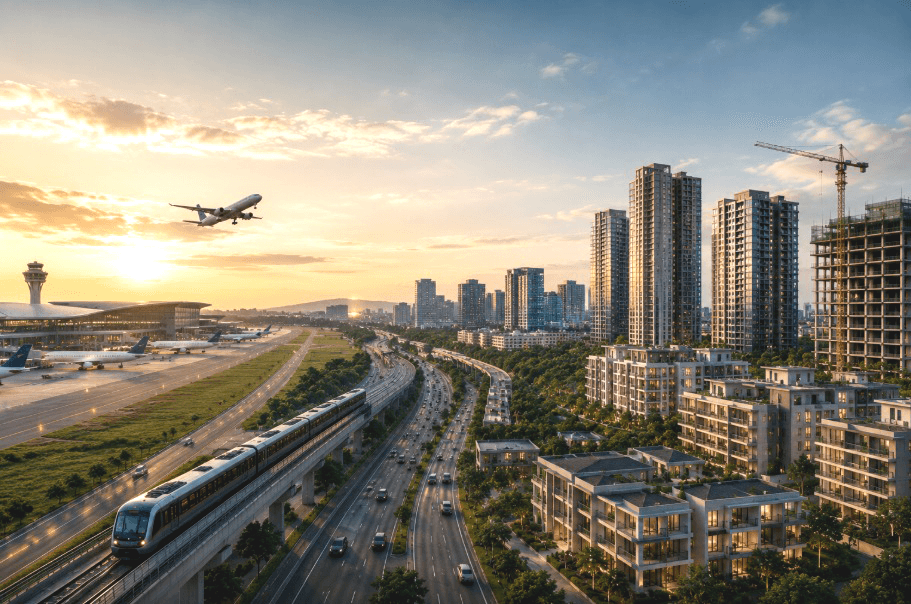
How Bengaluru’s Second Airport is Transforming Real Estate in the Southern Corridor
8th June 2026
Kanakapura Road, JP Nagar, Banashankari, Uttarahalli, Anjanapura, and the NICE Road belt were once considered South Bengaluru’s quieter residential side. While East Bengaluru and North Bengaluru dominated headlines with IT expansion, corporate leasing, and large-scale infrastructure growth, the southern corridor remained comparatively understated in mainstream investment conversations.
For years, Bengaluru’s real estate expansion largely revolved around areas close to IT parks, Outer Ring Road, Whitefield, and North Bengaluru. But that equation is changing rapidly.
The growing discussions around the Bangalore second airport near Kanakapura Road are beginning to redefine how investors, developers, and homebuyers view South Bengaluru. What was once considered as a residential belt is now emerging as one of the city’s most strategically important infrastructure-led real estate destinations.
And this shift is not just about aviation.
It is about connectivity, economic decentralisation, urban expansion, and long-term land appreciation.
Because whenever major infrastructure enters a city’s development narrative, real estate follows closely behind.
The proposed second airport is now becoming one of the strongest catalysts for the next phase of Bengaluru real estate growth.
Why Bengaluru Needs a Second Airport
With increasing passenger traffic at the existing airport in Devanahalli, the need for a second airport is no longer speculative — it is increasingly becoming an infrastructure necessity. Over the last decade, the city has consistently ranked among India’s strongest real estate and technology markets, attracting:
- Global IT companies
- Startups and unicorns
- Aerospace and manufacturing industries
- International business travellers
- Migrating professionals from across India
From a real estate perspective, improved aviation infrastructure often creates stronger demand for:
- Residential developments
- Rental housing
- Hospitality projects
- Commercial office spaces
- Transit-oriented townships
Areas with faster airport access typically become more attractive for professionals, NRIs, and business travellers, which directly contributes to long-term property appreciation.
Why South Bengaluru Is Suddenly Getting Serious Real Estate Attention
For a long time, South Bengaluru was primarily seen as a stable residential zone rather than an aggressive investment hotspot. People moved here for a certain quality of life — wider roads in select pockets, greener surroundings, reputed schools, established local markets, and comparatively calmer neighbourhoods than the city’s high-density eastern corridors.
However, over the last few years, the conversation around Bengaluru has begun to shift.
Locations like Kanakapura Road, JP Nagar, Banashankari, Uttarahalli, Anjanapura, and the NICE Road belt are no longer being viewed only as end-user residential markets. They are gradually entering the larger infrastructure and investment narrative of the city.
One important factor is land availability.
Compared to several saturated micro-markets in East and Central Bengaluru, parts of the southern corridor still offer relatively better scope for large-scale residential communities, plotted developments, and mixed-use projects. This gives developers an opportunity to create integrated urban spaces instead of overcrowded standalone apartment clusters.
The social infrastructure in South Bengaluru also plays a huge role in sustaining demand. Reputed educational institutions, healthcare centres, retail growth, cafes, and evolving lifestyle infrastructure have already created a strong liveability factor in the region. That matters because modern homebuyers are not only investing for appreciation anymore — they are prioritising long-term lifestyle value.
Now, the Kanakapura Road region is entering an entirely new phase.
Why Investors Are Watching South Bengaluru Closely
Markets that are already fully mature may offer stability, but they usually leave limited room for sharp long-term appreciation. On the other hand, entering a corridor too early — before infrastructure visibility or demand fundamentals become clear — can increase investment uncertainty.
What makes South Bengaluru interesting today is that it sits somewhere in between these two phases.
The region is no longer an emerging unknown, yet it is still evolving fast enough to create long-term investment potential. This is precisely why developers, investors, and market analysts are closely observing several micro-factors shaping the future of South Bangalore real estate.
Metro Expansion Is Improving Accessibility Beyond Traditional Hotspots
Connectivity has always been one of the biggest value drivers in the Bengaluru property market. The continued expansion of Namma Metro toward southern zones, locations like Kanakapura Road and Anjanapura. Areas that once felt distant are now becoming more connected to major employment hubs and central Bengaluru. At the same time, the NICE Road corridor has strengthened inter-city and intra-city mobility, improving access toward Mysuru Road, Electronic City, and other strategic zones.
Areas that were once considered distant residential pockets are now becoming more integrated with the city’s employment and commercial ecosystem. Better public connectivity generally increases residential demand, rental potential, and long-term market stability.
Kanakapura Road Is Transitioning Beyond Pure Residential Demand
Kanakapura Road is no longer being viewed only as an end-user housing destination. Real estate experts are watching the corridor because it still offers relatively better land availability compared to several saturated Bengaluru micro-markets.
Large land parcels create opportunities for:
- Integrated townships
- Mixed-use developments
- Premium gated communities
- Organised plotted projects
Combined with metro connectivity and the proposed Bangalore second airport, the corridor will gradually position itself as a long-term infrastructure-led growth belt.
Peripheral Southern Corridors Are Benefiting From Spillover Demand
This spillover effect is now becoming visible across peripheral southern corridors connected through NICE Road and arterial infrastructure networks. Investors are tracking these locations because infrastructure expansion often pushes development activity toward lower-density zones where future urban growth becomes more scalable. This creates early-stage opportunities before large-scale commercial saturation begins.
Plotted Developments Are Gaining Renewed Attention
Post-pandemic buyer behaviour has shifted considerably, with many investors preferring land-based assets that offer flexibility, lower-density living, and stronger long-term appreciation potential. Southern corridors still provide opportunities for plotted communities in locations where urban infrastructure is steadily improving.
For many investors, this creates a balance between future growth potential and relatively lower entry costs compared to fully mature city zones.
Mixed-Use and Transit-Oriented Projects Are Becoming More Relevant
Developers are increasingly focusing on mixed-use ecosystems where residential, retail, commercial, and lifestyle infrastructure coexist within the same urban framework. South Bengaluru is attracting attention because improving transit infrastructure can support this kind of integrated development model over the next decade.
This is particularly important in infrastructure-led real estate markets because buyers today prioritise convenience, accessibility, and long-term livability alongside investment returns.
Expert’s Observation: Not every project in the region will perform equally, and infrastructure announcements alone do not guarantee immediate appreciation. However, the larger macro-growth story surrounding South Bengaluru is becoming increasingly difficult for the Bangalore property market to ignore.
Conclusion
The story of Bengaluru’s second airport is not only about aviation infrastructure. This is South Bengaluru as a future-ready growth corridor with strong long-term real estate potential.
At a time when infrastructure-led investing is becoming increasingly important, working with an experienced real estate consultant in India can help investors identify high-potential opportunities with stronger long-term fundamentals.
This is where Somani Realtors continues to guide buyers and investors with market-driven insights, location expertise, and strategic real estate consultation. As a trusted real estate agency in Bengaluru, Somani Realtors helps clients navigate emerging investment corridors, premium residential opportunities, and infrastructure-backed property markets with a long-term perspective rooted in research, transparency, and evolving urban growth trends.
FAQs
Why is the Bangalore second airport important for real estate?
The second airport can improve connectivity, attract commercial activity, and increase long-term residential and land demand in South Bengaluru.
Which areas may benefit from Bengaluru’s second airport?
Kanakapura Road, South Bengaluru corridors, NICE Road belt, and nearby emerging residential zones may witness stronger real estate growth.
Is South Bangalore real estate a good investment opportunity?
South Bengaluru offers strong infrastructure growth, metro connectivity, better livability, and rising long-term investment potential.
How does infrastructure impact Bengaluru real estate prices?
Infrastructure projects improve accessibility and economic activity, which often increases residential demand and property appreciation over time.
Why are investors focusing on property near Bangalore airport zones?
Airport-linked infrastructure typically boosts commercial development, rental demand, connectivity, and long-term capital appreciation.