Why Brands Are Eyeing Tier 2 Cities — And Why Siliguri Could Be Your Next Destination
3rd July 2026
For decades, brand expansion in India followed a predictable script: conquer Mumbai, Delhi, Bengaluru, and Chennai first, then maybe think about everywhere else. That script is being rewritten. Tier 2 cities are no longer the consolation prize of a retail strategy — they're becoming the main event. And among the contenders, Siliguri, the gateway to North-East India, is quietly building a case for itself that's hard to ignore.
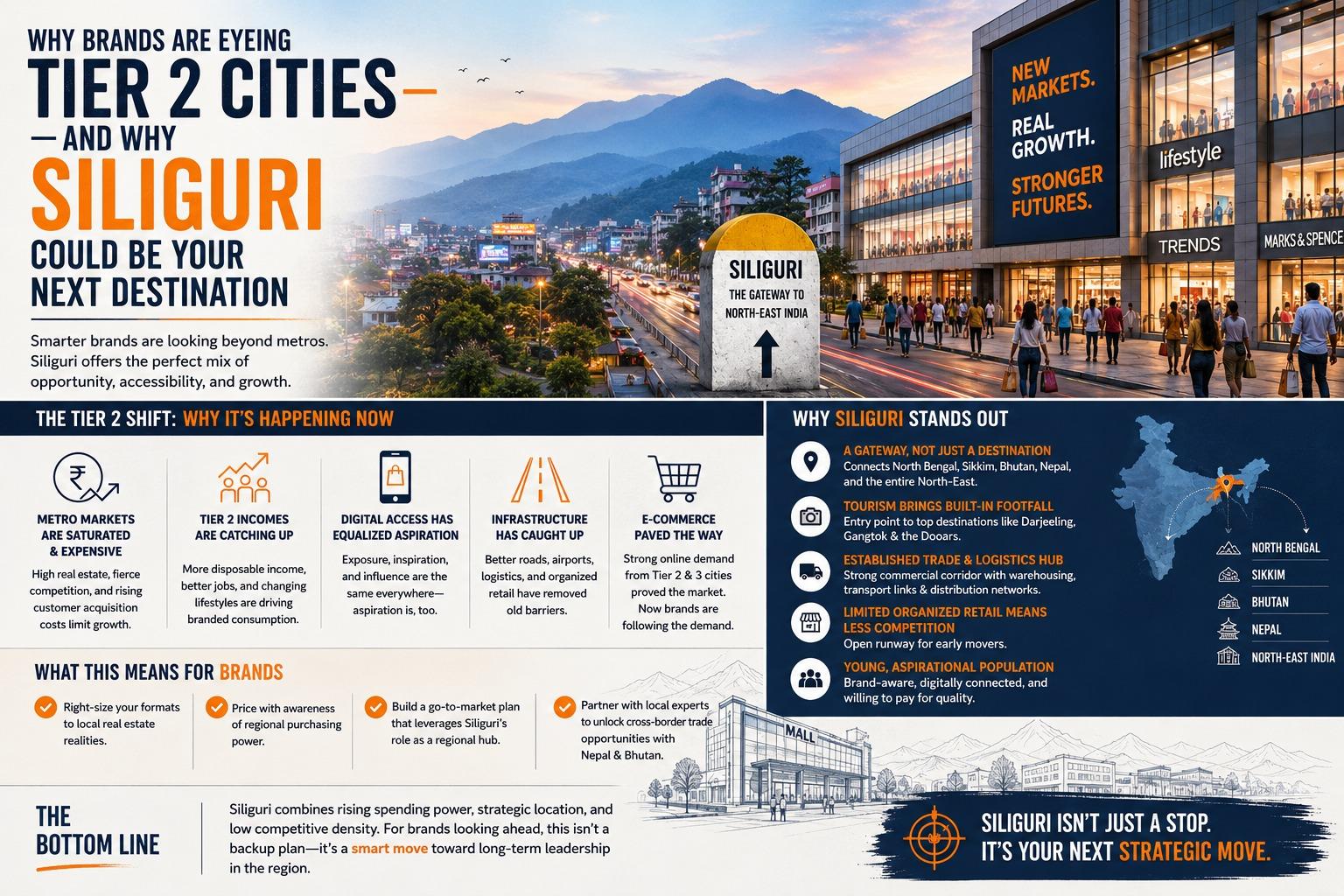
The Tier 2 Shift: Why It's Happening Now
A few converging forces are pushing brands beyond the metros.
Metro markets are saturated and expensive. Real estate, customer acquisition costs, and competition in Tier 1 cities have all climbed steeply. Every major mall in Delhi or Bengaluru already has five versions of the same brand competing for the same footfall. Growth at the margin is getting harder to find.
Tier 2 incomes are catching up. Rising disposable income, better employment opportunities, and the spread of nuclear family households in smaller cities mean more people with money to spend — and increasingly, the appetite to spend it on branded goods rather than local alternatives.
Digital access has equalized aspiration. Smartphone penetration and social media have given consumers in smaller cities the same exposure to global trends as their metro counterparts. People in Siliguri or Indore see the same Instagram ads, the same influencer content, and want the same products — often before the brand has even opened a store nearby.
Infrastructure has caught up too. Better roads, expanding airports, improved logistics networks, and the growth of organized retail and mall culture in smaller cities have removed many of the old operational barriers to entry.
E-commerce paved the way. Brands have already seen Tier 2 and Tier 3 cities driving a disproportionate share of online order growth. Physical expansion is often just brands following demand they've already proven exists.
Enter Siliguri: The Strategic Gateway
Siliguri isn't just another Tier 2 city on a spreadsheet of population numbers. It occupies a genuinely unique position on the map.
It's a gateway, not just a destination. Siliguri sits at the convergence point for North Bengal, Sikkim, Bhutan, Nepal, and the entire North-East region of India. A presence here isn't just a presence in one city — it's a foothold that can serve a much larger catchment area that's otherwise difficult and expensive to reach.
Tourism brings a built-in customer base. As the entry point to Darjeeling, Gangtok, and the Dooars, Siliguri sees a constant churn of domestic and international travelers. That's footfall many Tier 2 cities simply don't have, and it diversifies the customer base beyond local residents alone.
It's a established trade and logistics hub. Siliguri has long functioned as a commercial corridor connecting Eastern India to the North-East and beyond. This existing trade infrastructure — warehousing, transport links, distribution networks — significantly lowers the operational lift for a new entrant compared to a city starting from scratch.
Limited organized retail means limited competition. Much of Siliguri's retail landscape is still dominated by local and unorganized players. For a brand willing to move early, that's an open runway rather than a crowded one.
A young, aspirational population. Educational institutions and a growing services sector have built up a young consumer base in Siliguri that is brand-aware, digitally connected, and increasingly willing to pay for quality and recognition over the cheapest local option.
What This Means for Brands Considering the Move
Entering Siliguri isn't about replicating a flagship Delhi store and shrinking it. It calls for a few deliberate choices: right-sizing store formats to local real estate realities, pricing with an awareness of regional purchasing power, and building a go-to-market plan that accounts for the city's role as a hub rather than treating it as an isolated market. Partnerships with local distributors who already understand the cross-border trade dynamics with Nepal and Bhutan can also be a meaningful shortcut.
The Bottom Line
The brands winning the next decade of Indian retail won't be the ones simply doubling down on the same four metros. They'll be the ones reading the map correctly — spotting cities like Siliguri that combine rising consumer spending power, strategic geographic leverage, and relatively low competitive density. For a brand looking at where to go next, Siliguri isn't a backup option. It's a calculated bet on a city positioned to matter a great deal more in the years ahead.