Why Data Centre Growth Could Transform India's Housing Market by 2030
22nd August 2026
The number that should stop every homebuyer, developer, and investor in their tracks: India generates almost 20% of the world's data, yet it holds barely 4% of global data centre capacity. That gap isn't just a technology statistic. It's one of the biggest real estate opportunities of this decade, hiding in plain sight.
For years, India's housing story was written by IT parks, industrial corridors, and metro lines. Premium housing carried the market, but rising prices and affordability pressure have started to slow that momentum. Developers and investors are now searching for the next engine of growth, and increasingly, they're finding it in an unlikely place: server racks, cooling towers, and power substations.
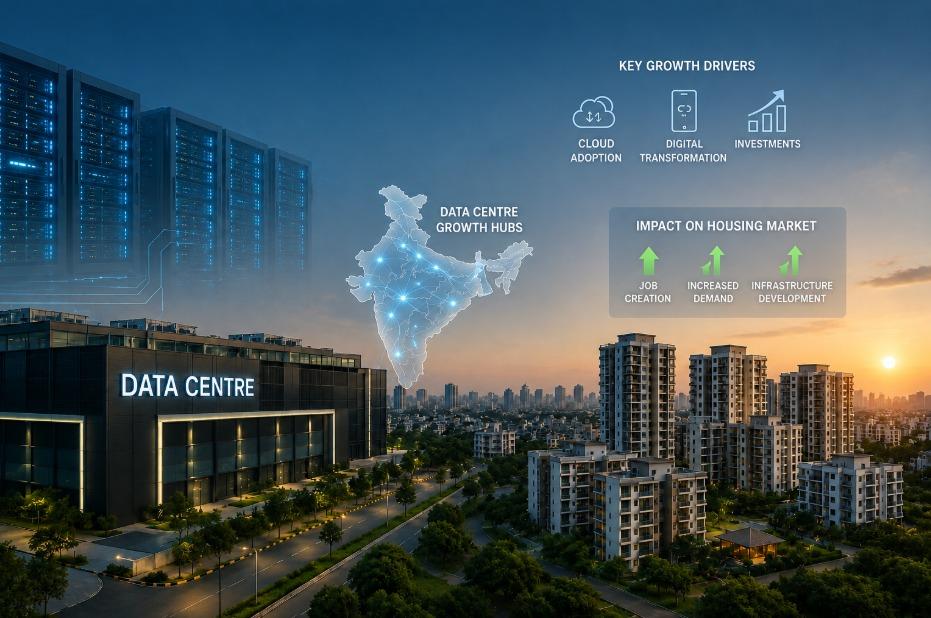
With over 250 data centres proposed across India by 2030 and India's data centre capacity expected to jump from roughly 1.5–1.7 GW today to nearly 12 GW by 2030 (a projected CAGR of 10.1% between 2026 and 2034), data centres in India are no longer a niche infrastructure play. They are becoming urban anchors, and everywhere they land, housing demand tends to follow. This article unpacks exactly how and why.
The Data Gap Fuelling the Boom in Data Centres in India
India's digital economy is expanding faster than its infrastructure can keep pace with. Cloud adoption, artificial intelligence workloads, 5G rollout, and expanding digital public infrastructure are all fuelling unprecedented demand for storage and compute capacity. Global hyperscalers and institutional investors have responded with an announced investment pipeline that could exceed USD 100 billion, subject to execution, power availability, and market demand.
A few headline moves make the scale clear:
- Google has proposed a $15 billion, 1 GW data centre hub in Visakhapatnam, commissioning by 2028.
- Digital Connexion, a Reliance joint venture, plans to invest $11 billion in an AI data centre in Andhra Pradesh.
- India's colocation capacity, currently at about 1.2 GW of core active IT load, has a locked-in pipeline to quadruple to nearly 4 GW by 2030, backed by roughly ₹1.5 lakh crore in capital expenditure.
This is the foundation of data centre growth in India, and it's growing far faster than the real estate sector's understanding of it.
How Data Centre Growth and Real Estate Are Converging
Unlike IT parks or office campuses, data centres don't attract housing demand through direct employment. In fact, a hyperscale facility runs on a surprisingly lean on-site team, typically just 0.5 to 3 jobs per MW. The real story of data centre growth and real estate lies in what surrounds the campus, not what happens inside it.
Every hyperscale investment pulls in power infrastructure, fibre connectivity, logistics networks, construction activity, and skilled ancillary employment, estimated at 10 to 20 jobs per MW, far exceeding direct staffing. This is where data centre growth and real estate genuinely intersect: as power-rich, fibre-connected corridors mature, they draw in warehousing, retail, commercial offices, and eventually residential townships. Historically, Indian urban expansion followed highways and IT parks. The next phase is increasingly likely to follow power grids and compute clusters instead.
The Golden Ring Effect: Where Housing Demand Actually Peaks
One of the most useful insights for buyers and investors is what can be called the "doughnut effect." The data centre campus itself remains a secure, low-density infrastructure zone, not a place people live or shop. The real appreciation happens in the surrounding 5–15 km "Golden Ring," where infrastructure upgrades, developer activity, and housing demand scale far more efficiently.
Within this ring, you typically see:
- Residential townships and rental housing
- Retail clusters and community services
- Mixed-use developments
- Parks, amenities, and civic infrastructure
- Increased job opportunities across construction, logistics, facilities management, and allied services
In short: the biggest opportunity for homebuyers may lie around a data centre, not directly beside it. That said, the Golden Ring is not a guaranteed win for every plot within it. Not every parcel inside this radius qualifies for the same uplift, and proximity comes with trade-offs of its own, covered in detail further below, that buyers should weigh before assuming automatic appreciation.
Data Centre Impact on Housing Market: By the Numbers
The scale of this shift becomes clearer once you look at the projections. Deloitte estimates India will need an additional 45–50 million sq. ft. of real estate and 40–45 TWh of incremental power by 2030 to support AI-led data centre growth. Square Yards Research goes further, estimating that the proposed data centre pipeline could generate roughly 195 million sq. ft. of residential space demand by 2030, built on:
- 9,030 MW of total lifetime proposed capacity
- 27,090 direct jobs and 4,06,350 ancillary jobs
- 43.3 crore sq. ft. of total urban space demand
- 19.5 crore sq. ft. translating into residential demand alone
This is the clearest evidence yet of the data centre impact on housing market trends across India. Every long-term ecosystem employee is estimated to generate 800–1,200 sq. ft. of cumulative urban space demand over time, across residential, retail, commercial, and civic use, with 25–40% of ecosystem jobs likely to convert into sustained residential demand nearby.
State-Wise Hotspots: Where Data Centres in India Are Concentrating
Mumbai currently leads the pack, commanding 53% of India's data centre market share, followed by Chennai (16%), Hyderabad (10%), the NCR/Noida belt (7%), Pune (7%), and Bengaluru (6%). But the map is expanding fast. Emerging hubs projected for significant capacity growth by 2030 include:
Maharashtra (Mumbai–Pune Belt)
- Amazon Data Services Land Acquisition: Amazon Data Services purchased a 38.18-acre land parcel in the Palava/Ambernath region near Mumbai from the Lodha Group (Macrotech Developers) for over ₹450 crore. Illustrating the rapid land appreciation driven by data centres, this same land was valued at approximately ₹4 crore per acre in 2021 and escalated to ₹12 crore per acre within three years.
- Extreme Land Appreciation (Mindspace Corridor): Industry benchmarks from tech corridors like Mindspace in Navi Mumbai highlight that property prices, previously around ₹4 crore per acre 4 to 5 years ago, have surged to as high as ₹40 crore per acre due to the massive surge in data centre infrastructure demand.
Gujarat
- Reliance's Gigawatt-Scale AI Push: Mukesh Ambani announced the development of a mega 3 GW data centre facility in Jamnagar. Backed by an estimated capital investment exceeding ₹2,50,000 crore ($30 billion), the project aims to establish one of the world's largest AI and cloud infrastructure hubs.
Delhi NCR & Haryana
- Anant Raj Limited: Real estate developer Anant Raj Limited announced a massive ₹18,000 crore expansion into the digital infrastructure sector. The company expects its data centre and digital infrastructure segment to generate 40% of its total corporate revenue within a four-year timeframe, shifting up from 5%.
Andhra Pradesh
- Visakhapatnam Hyperscale Hub: Anchored by Google’s proposed 1 GW AI hub and Digital Connexion’s (Reliance JV) planned $11 billion AI campus, the region is projected to generate over ₹10,000 crore in direct state revenues, proving how a single mega-project can instantly anchor a regional real estate market.
Notably, Uttar Pradesh (Noida–Greater Noida), Gujarat (GIFT City/Jamnagar), West Bengal, Haryana, and Odisha are all entering investor radars as Tier-2 markets with lower land costs and improving infrastructure
The Policy Push Behind India's Digital Infrastructure Boom
Government support is accelerating this trend. The Union Budget 2026–27 introduced a tax holiday until 2047 for eligible foreign cloud service providers operating through India-based data centre infrastructure. This sits alongside a wider set of enabling schemes: the India Semiconductor Mission 2.0, the Electronics Components Manufacturing Scheme, IT services simplification and safe harbour provisions, PSI schemes, and the IndiaAI Mission.
States themselves are rewriting development rules to accommodate hyperscale campuses, offering higher ground coverage, FAR optimisation, reduced setbacks, floor-height exemptions for cooling and technical equipment, and faster utility approvals. Haryana, Telangana, Maharashtra, and Uttar Pradesh are among the states actively adapting zoning norms, effectively creating a new category of infrastructure-led land value.
Where Data Centres in India are Actually Allowed to Be Built
It's worth being clear that hyperscale campuses cannot simply come up anywhere land is cheap. Setting up data centres in India involves a layered approval process, and this is exactly why the "Golden Ring" forms where it does rather than randomly around every city. Typical requirements include:
- Environmental clearance under the Environment Protection Act, 1986, along with sign-off from state pollution control boards
- Groundwater withdrawal approval, since the Central Ground Water Authority regulates extraction in 19 states and UTs, with State Ground Water Authorities covering the rest
- Zoning and land-use approval from local municipal and industrial development authorities, along with building-plan and fire-safety clearances under the National Building Code
- Power and grid connectivity assessments, given the enormous, continuous electricity draw of hyperscale facilities
- State-specific data centre policies, several of which (Maharashtra, Tamil Nadu, Telangana, Uttar Pradesh, Karnataka) now offer single-window clearance, though industry bodies note the process can still require 30 or more separate approvals
A Draft National Data Centre Policy is also in the works, proposing dedicated Data Centre Economic Zones, land pooling frameworks, and standardised siting norms. Until that policy is finalised, state-level rules and local resource availability, especially water and power, remain the deciding factors in where a project actually gets built.
What This Means for Homebuyers and Investors
For anyone tracking data centres in India as an investment theme, three things stand out. First, power availability is becoming as important a land-value driver as connectivity or transport once was. Second, infrastructure certainty, not workforce density, is what drives long-term appreciation around these corridors. Third, the opportunity isn't limited to Tier-1 metros; Tier-2 states with land, power access, and improving fibre infrastructure are entering the growth story early, often at more attractive entry prices.
Investors evaluating land near proposed hyperscale campuses should look closely at zoning status, power access, environmental clearances, and the state's long-term infrastructure commitments before acquiring property in these emerging corridors. Equally important is checking a project's water sourcing plan, its distance from the infrastructure buffer zone, and whether local noise ordinances have been factored into residential planning nearby, since these details separate a well-positioned Golden Ring investment from one that sits too close to the friction points.
Conclusion
Data centres in India are quietly rewriting the rulebook for urban growth. What began as a purely technological shift, driven by AI, cloud adoption, and India's yawning data-storage gap, is fast becoming one of the defining forces behind the next residential real estate cycle. The data centre impact on housing market trends is no longer theoretical; it's playing out in the Golden Rings forming around Mumbai, Hyderabad, Visakhapatnam, and a growing list of Tier-2 cities.
Understanding where this data centre growth is happening, and more importantly, where the surrounding ecosystem will mature next, requires more than just tracking headlines. It also means being honest about the trade-offs, from water and power strain to noise and siting restrictions, rather than treating every corridor near a hyperscale campus as an automatic buy. Real opportunity here requires local expertise, access to verified project data, and a clear read on zoning, resource, and infrastructure timelines specific to each corridor.
At Somani Realtor, we track these infrastructure-led growth corridors closely, combining on-ground market knowledge with data-backed research to help clients identify opportunities before they become mainstream. Whether you're a first-time homebuyer, a developer scouting land banks, or an investor looking to diversify beyond traditional residential markets, working with an experienced real estate consultant in India can make the difference between reacting to a trend and getting ahead of it.
Ready to explore India's next big real estate opportunity? Connect with Somani Realtor today to find out which data centre-led corridors fit your investment goals.
Frequently Asked Questions
1. How are data centres different from IT parks in driving real estate demand?
Unlike IT parks, which create demand through large on-site workforces, data centres operate with lean staffing (0.5–3 jobs per MW). Their real estate impact comes indirectly, through power infrastructure, fibre networks, and institutional investment that draw ancillary industries and housing to the surrounding area.
2. Which Indian cities are currently leading in data centre capacity?
Mumbai leads with roughly 53% market share, followed by Chennai, Hyderabad, the NCR/Noida region, Pune, and Bengaluru. Emerging hubs like Visakhapatnam, GIFT City, and parts of West Bengal and Odisha are gaining investor attention due to lower land costs.
3. How far from a data centre should I look for residential investment opportunities?
Based on current infrastructure patterns, the strongest housing demand and land value appreciation typically occur within a 5–15 km radius of a data centre campus, often referred to as the "Golden Ring," rather than immediately adjacent to it.
4. Is data centre-driven real estate demand only relevant to Tier-1 metros?
No. While Mumbai, Chennai, and Hyderabad currently dominate, states like Andhra Pradesh, Gujarat, Haryana, Uttar Pradesh, and Odisha are increasingly attracting hyperscale investment due to available land, improving power infrastructure, and supportive state policies.