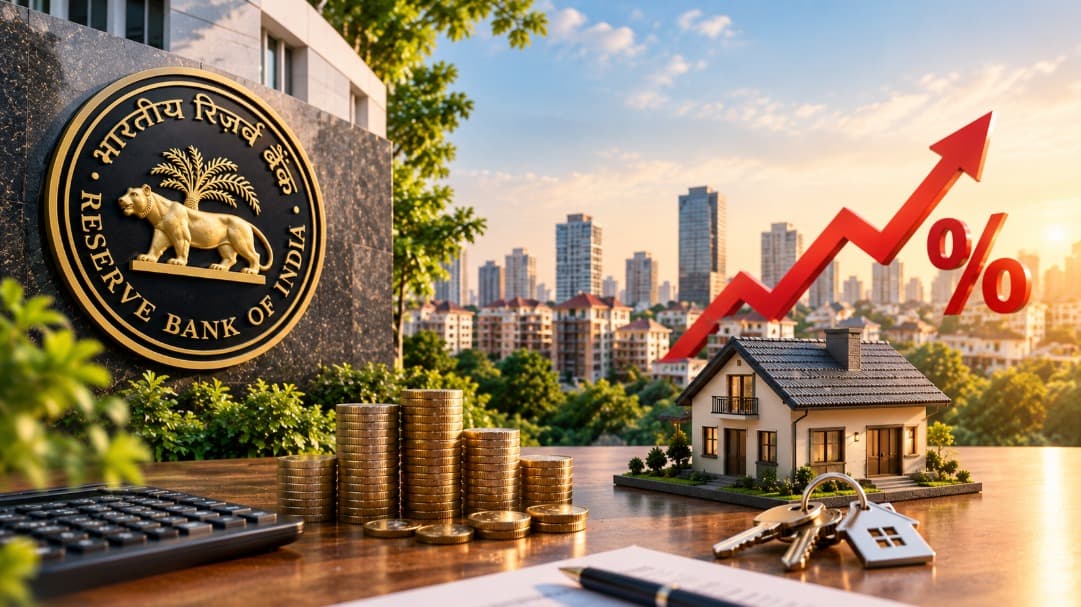
RBI Repo Rate Hike to 5.50%: What It Means for Homebuyers and the Real Estate Market
12th October 2026
9th October 2026
Six months ago, the Reserve Bank of India chose patience. This week, it chose action.
On 7 October 2026, the RBI's Monetary Policy Committee (MPC) announced an RBI repo rate hike of 25 basis points, taking the policy rate from 5.25% to 5.50%. It is the first increase in the benchmark rate since February 2023, and it comes with a sharper message than the number itself: the central bank has moved its stance to "calibrated tightening", which effectively takes rate cuts off the table for the near term.
For anyone planning to buy a home, or already paying an EMI, this is the moment the interest rate cycle officially turned. So what pushed the RBI to act, and what does the RBI repo rate 5.50% mean for your loan, your budget and the wider property market? Let us break it down.
Recap: Where We Left Off in April 2026
On 14th April 2026, we published Home Loan EMIs to Stay Stable as RBI Holds Repo Rate at 5.25%. Here is a quick look back at what that article covered:
- The decision: The MPC held the repo rate at 5.25%, giving home loan borrowers a stable, "neutral" environment.
- The backdrop: Tensions in West Asia had pushed crude oil close to the $110-per-barrel mark, with the Strait of Hormuz under pressure.
- The cost squeeze: Freight charges, TMT steel and electrical components were already getting costlier for builders.
- Our view then: We called it a "Goldilocks" window for buyers and flagged that West Asian inflation pressure could force a recalibration later.
That recalibration has now arrived. The pause that protected EMIs through the first half of the year has given way to the first hike of this cycle.
The October 2026 MPC Decision at a Glance
The RBI monetary policy 2026 review was held from 5 to 7 October 2026, the MPC's 63rd meeting, chaired by Governor Sanjay Malhotra.
Indicator | Before (April 2026 onwards) | After 7 October 2026 |
Policy repo rate | 5.25% | 5.50% |
Standing Deposit Facility (SDF) | 5.00% | 5.25% |
Marginal Standing Facility (MSF) and Bank Rate | 5.50% | 5.75% |
Policy stance | Neutral | Calibrated tightening |
FY 2026-27 GDP projection | 7.1% | |
FY 2026-27 CPI inflation projection | 5.2% |
Why Did the RBI Raise Rates? The Inflation Story
This hike is, above all, a response to inflation. The MPC described the inflation outlook as "not benign" compared with last year, and the numbers explain why.
Headline inflation is climbing
Consumer Price Index CPI inflation rose to 4.8% in August 2026, up from 4.5% in July, led mainly by food and fuel. Sugar and onion prices saw particularly sharp spikes. More worrying is the forecast: the RBI expects headline CPI to average close to 5.8% over the next three quarters, peaking at 6.0% in Q3 (October to December 2026). That is well above the RBI's 4% target and brushing against the upper tolerance limit of 6%.
Growth is strong enough to absorb a hike
Here is the other side of the equation. Real GDP grew 7.8% in Q1 FY27, and the RBI has raised its full-year growth projection to 7.1%. Bank credit was growing at 18.1% year on year as of mid-September, against 10.4% a year earlier. With the economy running this strong, the RBI judged that it could tighten without derailing growth.
What Does "Calibrated Tightening" Really Mean?
This phrase matters more to borrowers than the 25 basis points.
Under a neutral stance, the next move could have been a cut, a pause or a hike. Under calibrated tightening, the next move can only be a hike or a pause.
Break the term into its two parts, and it becomes easier to read. "Tightening" means the RBI is deliberately making money costlier to borrow, so that spending slows and prices cool down. "Calibrated" means it will do this in small, measured steps, reviewing the data at every meeting instead of committing to a fixed number of hikes in advance. Think of it as the RBI pressing the brake gently and checking the road before pressing again.
For homebuyers, the practical message is simple: do not plan your purchase around a rate cut in the coming months. Home loan rates are more likely to stay where they are or edge higher, and any relief will come only once inflation is clearly back under control.
The MPC has said the length and depth of this cycle will depend on how inflation behaves, especially core inflation, the spread of price pressures and any second-round effects of the supply shock.
Some market participants already expect more. HSBC Global Investment Research, for instance, has forecast another 25 bps hike at the December meeting. That is a forecast, not a certainty, but it tells you which way the wind is blowing.
The Geopolitical Shadow Has Not Lifted
While this is largely a domestic inflation story, the global backdrop has not improved since April. A re-escalation of the West Asia conflict in September pushed the Indian crude basket to an average of US$116.1 per barrel, compared with US$82.0 in July. Tensions along international borders continue to keep energy and shipping markets on edge.
The US Federal Reserve also raised rates by 25 bps in September, and several other major central banks have tightened. For India, this means imported inflation through fuel and a need to keep the rupee stable, both of which supported the case for a hike.
Repo Rate Hike Impact on Homebuyers
Now to the question most of our readers care about. What is the repo rate hike impact on homebuyers?
If you have a floating-rate home loan
Most home loans in India today are linked to an external benchmark, usually the repo rate. When the repo rate rises, your lender is likely to raise your interest rate at the next reset date, as per your loan agreement. Banks will usually give you two choices: pay a higher EMI or keep the EMI the same and extend the tenure.
Here is an illustrative look at what a 0.25% rise could mean on a 20-year loan, assuming the rate moves from 7.50% to 7.75%:
Loan amount | EMI at 7.50% | EMI at 7.75% | Monthly increase | Extra interest over 20 years |
₹50 lakh | ₹40,280 | ₹41,047 | ₹768 | about ₹1.84 lakh |
₹75 lakh | ₹60,419 | ₹61,571 | ₹1,152 | about ₹2.76 lakh |
₹1 crore | ₹80,559 | ₹82,095 | ₹1,536 | about ₹3.69 lakh |
Note: These figures are illustrative. Your actual rate depends on your lender's spread, your credit profile and your loan terms.
The monthly jump looks modest. The bigger risk is the direction. If the December meeting brings another hike, these increases will stack up.
If you are planning to buy a home
For new buyers, the hike reduces loan eligibility slightly, because banks calculate how much you can borrow based on the EMI your income can support. A higher rate means a slightly smaller sanctioned loan for the same salary.
But this is not a reason to panic. Home loan rates remain far below the double-digit levels seen in earlier tightening cycles. And waiting has its own cost: if rates rise again in December, and if construction costs keep climbing, both the loan and the property could cost more later.
Smart moves for borrowers right now
- Check your reset date: Know when your lender will pass on the hike.
- Prefer a higher EMI over a longer tenure: if your budget allows. Extending tenure quietly adds a lot of interest.
- Consider part-prepayment: Even small annual prepayments cut the impact of rising rates.
- Compare your spread: If your lender charges a high spread over the repo rate, a balance transfer may be worth exploring.
- Lock in your purchase decision sooner: if you have already shortlisted a property and your finances are ready.
Impact of Repo Rate Hike on Real Estate Companies
The impact of repo rate hike on real estate goes beyond buyers. Developers feel it on several fronts.
Higher cost of funds
Builders rely on construction finance and working capital loans. A higher repo rate raises borrowing costs for developers, which squeezes margins, especially for those with heavy debt.
Rising input costs
As we noted in April, steel, cement, copper and freight were already getting costlier because of West Asia disruptions. Higher crude prices in September add further pressure on transport and material costs.
Demand may slow, mostly in affordable and mid-income homes
Price-sensitive segments, where buyers stretch their loan eligibility the most, usually feel rate hikes first. Premium and luxury buyers tend to be less affected because they rely less on borrowing.
Pricing and offers
Developers facing slower enquiries may respond with payment plans, subvention-style schemes or festive offers to keep sales moving. At the same time, rising input costs make deep price cuts unlikely.
Stronger, well-capitalised players gain ground
In tightening cycles, developers with healthy balance sheets, ready inventory and strong delivery records tend to hold up better. Buyers become more cautious and prefer brands they can trust.
What to Watch Next
- 21 October 2026: The MPC minutes will be published, revealing why two members preferred a neutral stance.
- Monthly CPI data: The Q3 inflation peak of 6.0% will be the key test.
- Crude oil and West Asia: Any further escalation will feed directly into fuel and construction costs.
- 2 to 4 December 2026: The next MPC meeting, where the choice will be a hike or a pause.
Our Analytical View: A Measured Turn, Not a Shock
Looking at the full picture, this hike is a pre-emptive move rather than a panic response. Growth is strong, credit is expanding fast, inflation is rising and broadening. Against that mix, a 25 basis point increase is a measured step to stop inflation from settling at uncomfortable levels.
For the housing market, the impact in the short term will be moderate. EMIs will rise a little, loan eligibility will tighten slightly, and some buyers may pause to watch December's decision. The real shift is psychological. The era of falling rates that began in 2025 is over, at least for now.
Our April article argued that buyers should use stability as a window rather than wait for perfect conditions. That view has only become sharper. Rates are now rising, construction costs remain elevated and the policy signal points to further tightening, not relief. For genuine end-users with stable incomes, waiting for rates to fall again may mean paying more on both the loan and the property. Real estate, anchored by real end-user demand, remains one of the most dependable long-term assets in an uncertain world. The key is to buy with clear numbers, the right loan structure and the right partner.
Find Your Steady Ground with Somani Realtors
When interest rates change direction, the right guidance matters more than ever. As a trusted real estate company in India, Somani Realtors has guided homebuyers through every kind of market cycle for over 35 years, staying true to our "Home for All" philosophy.
From ready-to-move apartments to upcoming projects across Kolkata, our team helps you shortlist the right property for your budget. Through our loan assistance service and long-standing tie-ups with leading financial institutions, we help you compare home loan options, understand the impact of rising rates on your EMI and choose a structure that works for you.
Rates may rise and fall, but a well-chosen home stays with you for life. Connect with Somani Realtors today and take your next step with confidence.
FAQs
1. What is the current RBI repo rate?
The RBI repo rate is currently 5.50%, after the MPC raised it by 25 basis points on 7 October 2026.
2. Why did the RBI hike the repo rate in October 2026?
The RBI raised rates mainly to control rising inflation. CPI inflation rose to 4.8% in August 2026, core inflation is broadening, crude oil prices jumped after the West Asia conflict re-escalated, and the monsoon ended 13% below normal.
3. Will my home loan EMI increase after the RBI repo rate hike?
If you have a floating-rate loan linked to the repo rate, your interest rate is likely to rise at your next reset date. You can usually choose between a higher EMI or a longer tenure.
4. How much will the EMI increase on a ₹50 lakh home loan?
On a 20-year, ₹50 lakh loan, a 0.25% rise from 7.50% to 7.75% would raise the EMI by roughly ₹768 a month. Actual figures depend on your lender and loan terms.
5. What does "calibrated tightening" mean?
It means the RBI has ruled out rate cuts in the near term. The next policy move can only be a hike or a pause, depending on how inflation develops.
6. When is the next RBI MPC meeting?
The next MPC meeting is scheduled for 2 to 4 December 2026. The minutes of the October meeting will be released on 21 October 2026.
7. Is it still a good time to buy a home after the repo rate hike?
For end-users with stable finances, it can still be a sensible time. The hike is modest, and further hikes or rising construction costs could make buying later more expensive. Assess your budget and loan eligibility carefully before deciding.
8. How does the repo rate hike affect real estate developers?
Developers face higher borrowing costs, rising input costs and possibly slower demand in affordable and mid-income segments. Well-capitalised developers with strong delivery records are usually better placed to handle such cycles.