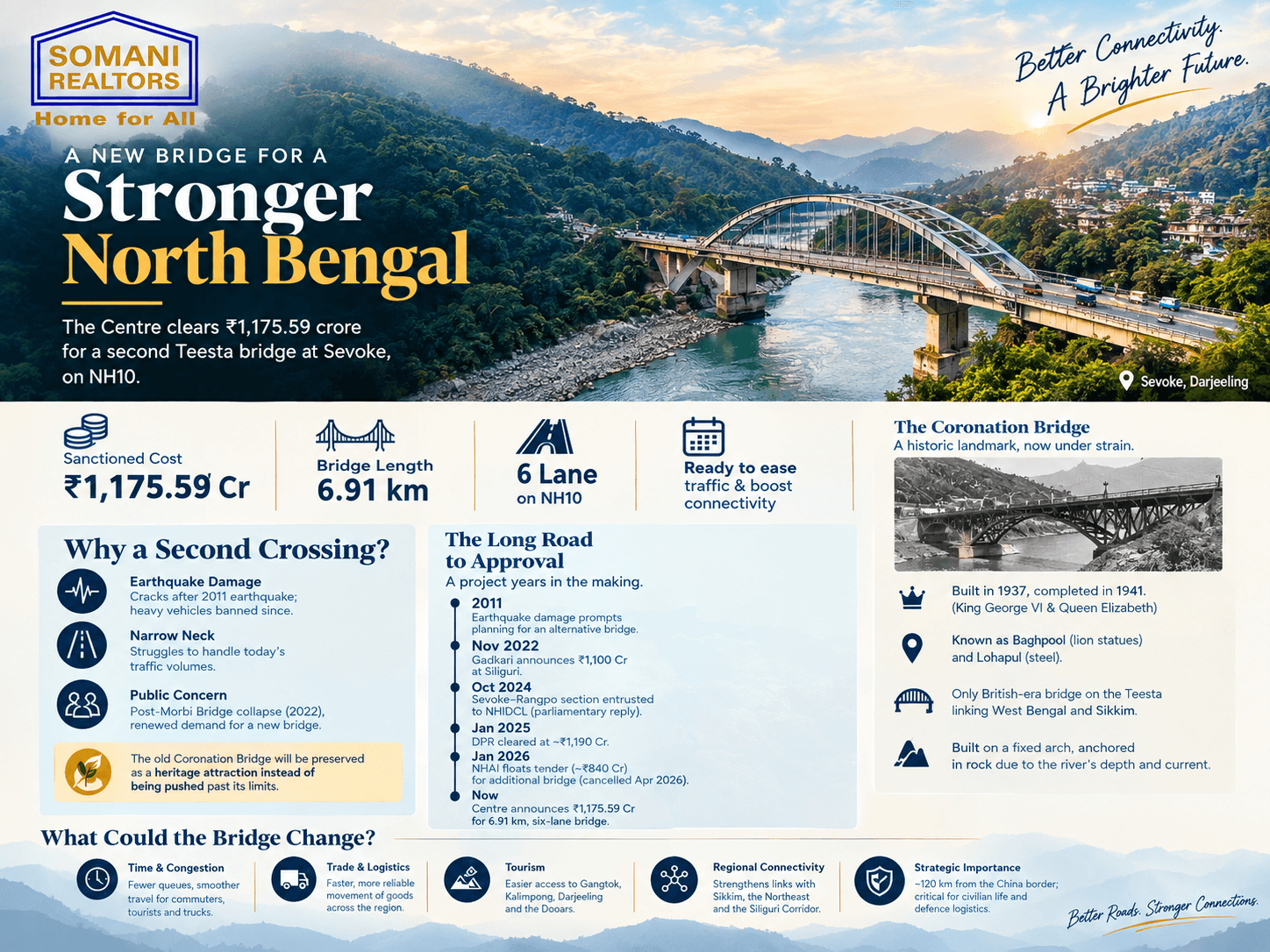
Second crossing beside the historic Coronation Bridge, on the lifeline road to Sikkim and the Northeast.
5th October 2026
Sanctioned Cost : 1.175.59 Cr.
Bridge length : 6.91 km
6 Lane on NH10
In 1941 the year old bridge reopened.
The announcement:
Union Road Transport and Highways Minister Nitin Gadkari has announced central approval of ₹1,175.59 crore for a 6.91-km, six-lane bridge across the Teesta River at Sevoke, in Darjeeling district, West Bengal. The structure will be built on National Highway 10 and is intended as an alternative to the Coronation Bridge, which was commissioned in 1941.
The government's stated aims are straightforward: a higher-capacity route along a key corridor, stronger links between Sikkim, the northeastern states and the Siliguri Corridor, and smoother movement of passengers and freight.
Why is this such an important spot?
Sevoke is a small town on the bank of the Teesta, close to Siliguri and the Sikkim border. NH-10 runs through it, connecting the town to Gangtok and Siliguri, while NH-17 begins near the Coronation Bridge and heads to Guwahati. Anything travelling from the plains towards Sikkim, Kalimpong, the Dooars or Bhutan funnels through this one stretch.
The location also carries strategic weight. Reports describe the crossing as roughly 120 km from the China border, and it sits at the edge of the narrow Siliguri Corridor that ties the Northeast to the rest of India. Reliable road capacity here matters for civilian life and for defence logistics alike.
The Coronation bridge : a landmark under the strain
The Coronation Bridge, also called the Sevoke Roadway Bridge, was built to mark the coronation of King George VI and Queen Elizabeth. Its foundation stone was laid in 1937 by the then Governor of Bengal, John Anderson, and it was completed in 1941. Locals know it as Baghpool, a name tied to the lion statues at one entrance, and as Lohapul for its steel.
The engineering is distinctive. The depth and current of the Teesta made it impractical to found the structure on the riverbed, so the bridge rests on a fixed arch whose ends are anchored in rock on either bank. It remains the only British-era bridge on the Teesta linking West Bengal and Sikkim.
Why does it need relief?
● Earthquake Damage : Cracks appeared after the 2011 earthquake, and the moving of heavy vehicles have been banned ever since.
● A Narrow Neck : The roadway struggles to cope-up with today’s heavy traffic volumes.
● Public Concern : After the Morbi Bridge collapse in Gujrat in 2022, social organisations in North Bengal renewed calls for a new Sevoke bridge, pointing to the age of the structure.
A second crossing lets the old arch be preserved as a heritage attraction rather than pushed past its limits.
A long road to approval :
The project has a long and sometimes frustrating history, and the figures have moved along the way.
● After 2011, The earthquake damage prompted the Centre to begin planning an alternative bridge. Land acquisition problems hold things up for years.
● November 2022. At Siliguri, Gadkari says a Teesta bridge will soon be built at a cost of about ₹1,100 crore.
● October 2024. The Sevoke–Rangpo section of NH-10 is entrusted to NHIDCL, as stated in a parliamentary reply.
● January 2025. The Teesta bridge project is cleared, with a detailed project report costing at about ₹1,190 crore.
● January 2026. NHAI floated an EPC-mode tender for an additional major bridge near km 591.310 of NH-10, valued at about ₹840 crore.
● April 2026. That tender was cancelled for administrative reasons, with work expected to begin that month.
● Now. The Centre announces ₹1,175.59 crore for a six-lane, 6.91-km bridge.
Stage | Figure Reported | Detail |
Nov 2022 announcement | ~₹1,100 crore | Statement by the Union minister |
Jan 2025 DPR | ~₹1,190 crore | Prepared by state PWD after approval |
Jan 2026 NHAI tender | ~₹840.29 crore | Additional major bridge, EPC mode (cancelled April 2026) |
Current sanction | ₹1,175.59 crore | 6.91 km, six lanes, NH-10 |
What could the bridge change?
Time and Congestion
More lanes and a modern deck should ease the queues that build up at Sevoke, saving time for commuters, tourists and trucks.
Trade and Logistics
Sikkim and the northeastern states depend heavily on road freight through this corridor. Faster, more reliable movement of goods supports trade and commerce across the region.
Tourism :
Gangtok, Kalimpong, Darjeeling and the Dooars all draw visitors who pass through Sevoke. A smoother approach helps that economy.
Regional Connectivity :
Earlier plans described the crossing as linking Sevoke Bazaar with the Dooars and fitting into the proposed Siliguri Ring Road and Siliguri–Gorakhpur Expressway. The ministry also says the project will benefit local communities and businesses.
A wider corridor upgrade:
Road works are also under way on the stretch from Balason Bridge in Siliguri to the Sevoke Army Cantonment and onward to the Coronation Bridge. Separately, the 44.98-km Sivok–Rangpo railway line, with its many bridges and tunnels, is being built to bring rail to Sikkim.
The Challenges Ahead :
● Delivery. A sanction is not a finished bridge. A fresh tender, contract award and construction timeline are still to come, and the earlier tender was cancelled.
● Terrain and Climate. The Teesta valley is geologically active and flood-prone, so design and construction must plan for extreme events.
● Coordination. Years of jurisdictional back-and-forth between state and central agencies caused earlier delays. Smooth handover matters.
● Land and Environment. Acquisition and approvals have held up this project before and can do so again.
What to watch next :
● Publication of a new tender and its bid dates.
● The awarded contractor and the formal construction schedule.
● Foundation stone or groundbreaking events
● Plans for the coronation bridge’s long term conservation.
Conclusion :
For Siliguri, the Dooars and Sikkim, a second crossing at Sevoke has been promised for the better part of a decade. The ₹1,175.59 crore sanction is the strongest signal yet that it will happen. If delivered well, it will make a vital road safer and faster, and give a 1941 landmark the chance to be admired rather than overworked.