Bengaluru's Next Growth Story: 9 New Townships and 312 Km of New Metro Lines
24th October 2026
14th October 2026
On Monday, 5 October 2026, Karnataka Chief Minister DK Shivakumar outlined a 10 to 15 year development blueprint for the Bengaluru Metropolitan Region (BMR). The plan was discussed at a meeting of the advisory committee on the economic development of the region, held at the Chief Minister's official residence.
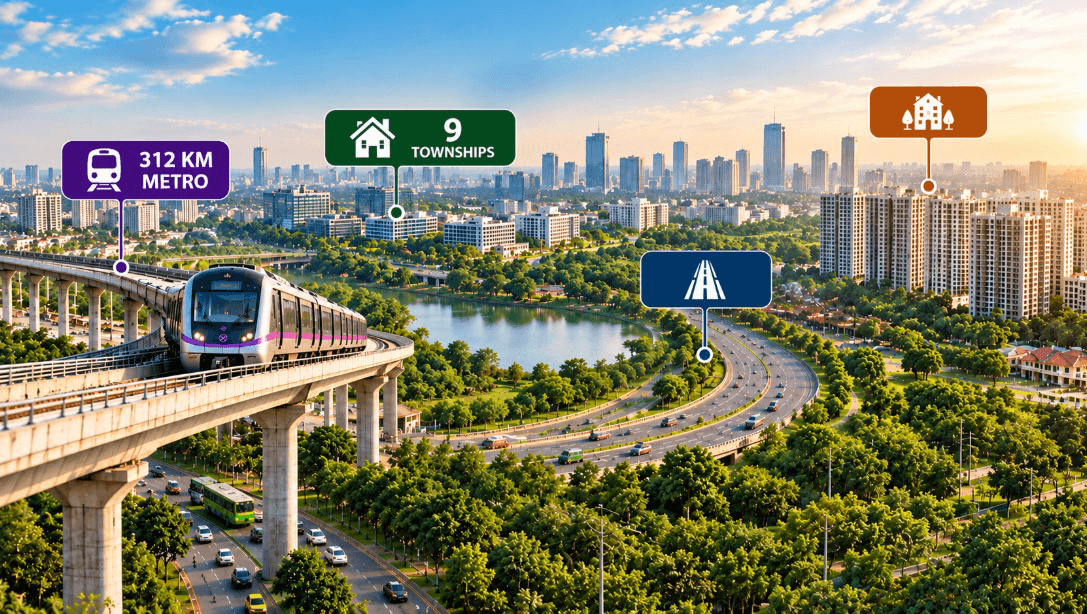
The blueprint covers nine integrated industrial townships, a 312 km Bengaluru Metro expansion by 2037, a 210 km ring road connecting 10 hubs, a 270 km Regional Rapid Transit System (RRTS) and a housing programme of 6 to 6.5 lakh homes.
The stated objective is to ease pressure on Bengaluru's congested core by spreading jobs, housing and transport across the wider metropolitan region. Transport, housing, water supply and industry are being planned together under one framework rather than as separate schemes.
For the Bengaluru real estate market, this is one of the most comprehensive infrastructure roadmaps announced in recent years. This article explains what the plan includes, which parts are already in motion, which are still proposals, and how the announcement may shape Bengaluru property market trends over the coming decade.
Key Takeaways
- Nine integrated industrial townships are planned across the BMR on 13,500 acres, of which 7,900 acres have already been acquired.
- The Metro network is targeted to grow by an additional 312 km by 2037, supported by 72 km of additional suburban rail.
- A 210 km ring road linking 10 hubs and a 270 km RRTS to Tumakuru, Mysuru and KGF are among the proposals.
- The housing plan covers 6 to 6.5 lakh homes, including housing for 40,000 to 50,000 industrial workers.
- Most transport components are at the proposal stage, so buyers should treat them as long-term growth signals rather than near-term deliverables.
Bengaluru's BMR Development Plan at a Glance
The table below summarises the headline components of the blueprint as reported after the 5th October meeting.
Component | Scale | Current Status |
Planning horizon | 10 to 15 years | Blueprint under preparation |
Integrated industrial townships | 9 across the BMR | Proposed |
Township land acquired | 7,900 acres | Acquired |
Additional township land | 5,600 acres | Acquisition under way |
Metro expansion | Additional 312 km by 2037 | Proposed |
Suburban rail | Additional 72 km | Proposed |
Ring road | 210 km, linking 10 hubs | Proposed |
PRR Phase 2 to NICE Road link | Connector proposal | Discussed |
RRTS corridors | 270 km to Tumakuru, Mysuru and KGF | Proposed |
Housing | 6 to 6.5 lakh homes | Plan prepared |
Industrial worker housing | 40,000 to 50,000 workers | Proposed |
AI City and AI university | Land to be identified | Officials directed to identify land |
What the Plan Includes: A Closer Look
1. Nine New Townships on 13,500 Acres
The townships are the most advanced part of the plan, with land acquisition already underway.
- Total land: 13,500 acres earmarked across the BMR
- Already acquired: 7,900 acres
- Under acquisition: 5,600 acres
- Average size: roughly 1,500 acres per township
- Worker housing: homes for 40,000 to 50,000 industrial workers
- AI City and AI university: officials directed to identify land for both
- Locations: not yet announced; earlier BMRDA proposals focused on Bidadi, Solur near Magadi and Nandagudi near Hoskote, but these remain unconfirmed
2. 312 Km Bengaluru Metro Expansion by 2037
A long-term network target that could reshape how the city commutes.
- Metro addition: 312 km more Namma Metro by 2037
- Suburban rail: an additional 72 km to link Bengaluru with nearby towns
- Current stage: a target, not a list of sanctioned lines
- Next steps for each line: DPR, state and central approvals, funding, tendering and construction
- Buyer impact: peripheral areas become more practical for daily commuting
3. 210 Km Ring Road Connecting 10 Hubs
A new road loop between the Peripheral Ring Road (PRR) and the Satellite Town Ring Road (STRR).
- Length: 210 km, linking 10 additional growth hubs
- Key connector: PRR Phase 2 to be linked with NICE Road
- Background: first proposed in 2007 as the Intermediate Ring Road, revived in 2026 with a revised alignment
- Reported route (April 2026): Thattekere, Harohalli, Bidadi, Tavarekere, Nelamangala, Devanahalli, Hoskote, Dommasandra and Anekal
4. 270 Km RRTS to Tumakuru, Mysuru and KGF
High-speed regional rail to bring satellite cities closer to Bengaluru's job hubs.
- Corridors: Bengaluru to Tumakuru, Mysuru and KGF
- Total length: 270 km
- High-speed rail: suggestion to extend the proposed Mumbai-Bengaluru line up to Mysuru
- Buyer impact: easier commutes from satellite towns to the city
5. Housing, Water and Civic Services
The part of the plan that most directly affects day-to-day living on the city's fringe.
- Housing target: 6 to 6.5 lakh homes across the region
- Civic coverage: all of Bengaluru Urban district to come under urban local bodies
- Water and sewerage: BWSSB coverage to extend to areas not currently served
- Water demand: about 3,600 MLD projected by 2037, with recycling and lake rejuvenation planned
- Buyer impact: fringe layouts relying on borewells and tankers stand to gain most, though no timeline has been set
What This Means for the Bengaluru Real Estate Market
The clearest message from the blueprint is direction. The state is planning for growth across the wider metropolitan region rather than concentrating it within the existing city limits. Industrial townships bring jobs, jobs bring housing demand, and new transport links make those locations easier to live in.
Historically, infrastructure announcements in Bengaluru have influenced land and housing prices well before projects were completed. Corridors such as Whitefield, Electronic City and the airport belt along Devanahalli all gained value as connectivity improved.
Corridors Likely to Feel the Impact
Based on the reported ring road alignment and the transport proposals, the following corridors are closely linked to the plan.
Corridor | Key Localities | Link to the BMR Plan |
East Bengaluru | Hoskote, Whitefield-Hoskote Road, KR Puram, Old Madras Road, Budigere Cross | Hoskote is on the revived ring road alignment; earlier township node at Nandagudi near Hoskote |
North Bengaluru | Devanahalli, Yelahanka, Chikkajala, Airport Road | Devanahalli is on the revived ring road alignment; airport-led commercial growth |
South-East Bengaluru | Sarjapur Road, Dommasandra, Panathur, Varthur | Dommasandra is on the revived ring road alignment |
South Bengaluru | Anekal, Attibele, Electronic City, Bannerghatta Road | Anekal is on the revived ring road alignment; PRR Phase 2 to NICE Road link |
West Bengaluru | Bidadi, Nelamangala, Tumakuru Road, Mysuru Road | Bidadi and Nelamangala on the ring road; RRTS to Tumakuru and Mysuru |
ALSO READ: How Bengaluru's Second Airport is Transforming Real Estate in the Southern Corridor
Bengaluru Property Market Trends to Watch
1. Early pricing of infrastructure. Corridors confirmed for new Metro lines or ring road sections are likely to see buyer interest well before construction begins. Locations with projects near existing or under-construction Metro stations may continue to hold a premium.
2. Rental demand near townships. Industrial townships create a resident workforce. Rental and entry-level housing demand typically rises within a few kilometres of large employment hubs.
3. Plotted and mid-segment growth along ring roads. Ring roads tend to change land use faster than Metro lines. Plotted developments, warehousing and mid-segment housing often appear along the alignment before the road is fully complete.
4. Larger affordable housing supply. The proposed 6 to 6.5 lakh homes could add significant supply in the affordable and worker housing segments, which may keep entry-level prices more balanced in some peripheral pockets.
5. Better civic services in fringe areas. Bringing peripheral areas under urban local bodies and BWSSB coverage could improve liveability and long-term value in layouts that currently lack piped water and sewerage.
What Buyers and Investors Should Keep in Mind
- Separate confirmed from proposed. The township land acquisition is underway. The Metro, ring road and RRTS are proposals that still need DPRs, funding and approvals.
- Plan for a long horizon. The blueprint runs over 10 to 15 years, so investment decisions should account for the time it takes infrastructure to be delivered.
- Verify developer claims. If a project highlights an upcoming Metro line or ring road, check whether that corridor is sanctioned or only part of a long-term plan.
- Check RERA and civic records. Confirm RERA registration, approvals and property tax status before buying, especially in newly included areas.
Expert's Observation: The BMR blueprint gives the Bengaluru real estate market a clear long-term direction. Not every corridor will benefit equally or at the same pace. Locations that already have functioning connectivity, social infrastructure and active employment hubs, and that also sit on the proposed growth network, offer a more balanced combination of present-day liveability and future potential.
Somani Realtors: Your Partner in Bengaluru's Next Growth Story
Large infrastructure plans create opportunity, but choosing the right corridor, project and price point needs verified information and on-ground market knowledge. This is where an experienced real estate consultant in India like Somani Realtors adds value. With over 35 years of experience, 300+ successfully marketed projects and more than 250 lakh sq. ft. transacted, the team closely tracks Bengaluru's key corridors, from Sarjapur Road and Whitefield-Hoskote Road to Yelahanka and Attibele. Somani Realtors partners with leading developers such as Godrej Properties, Sobha, Lodha, Birla Estates and Brigade Group, and holds a 4.7 Google rating. Every recommendation focuses on RERA-compliant projects and transparent transactions, with end-to-end support from site visits and loan assistance to interiors and final possession.
Somani Realtors' Bengaluru Projects Along Key Growth Corridors
Several projects listed by Somani Realtors sit in the corridors linked to the BMR plan.
Project | Location | Developer | Configuration |
Whitefield-Hoskote Road, next to Hopefarm Channasandra Metro Station | Mahindra Lifespace Developers | 3, 3.5 and 4 BHK | |
Old Madras Road, KR Puram | Brigade Group | Studio, 1, 2, 2.5 and 3 BHK | |
Bellary Road, Yelahanka | Godrej Properties | 3, 3.5 and 4 BHK | |
Panathur Road, Balagere | Sobha Limited | 3 BHK | |
Sarjapura-Varthur Road | Mana Projects | 2, 3, 3.5, 4 and 5 BHK | |
Sarjapur | Birla Estates | 1, 2, 3 and 4 BHK | |
Nandini Circle, off Sarjapur | Lodha Group | 3 and 4 BHK | |
Attibele Industrial Area, Krishnasagara | Sobha Limited | 1, 2, 3 and 4 BHK |
Find the Right Property Before the Next Growth Cycle
The Bengaluru Metro expansion, the new townships and the ring road network will reshape the city's map over the next decade. Buyers who understand which corridors are backed by real progress, and which are still at the planning stage, will be in a stronger position to make confident decisions.
As a trusted real estate agency in Bangalore, Somani Realtors helps homebuyers and investors compare projects, evaluate corridors and choose properties aligned with Bengaluru's long-term growth. Connect with the Somani Realtors team to explore verified residential projects across the city's emerging growth corridors.
FAQs
What is Bengaluru's new 10 to 15 year BMR development plan?
It is a long-term blueprint for the Bengaluru Metropolitan Region outlined by Chief Minister DK Shivakumar on 5 October 2026. It includes nine integrated industrial townships, an additional 312 km of Metro by 2037, 72 km of additional suburban rail, a 210 km ring road, a 270 km RRTS and 6 to 6.5 lakh homes.
Where will Bengaluru's nine new townships be located?
The exact locations have not been announced. The government has acquired 7,900 acres and is acquiring another 5,600 acres, making up a total of 13,500 acres across the BMR. Earlier BMRDA proposals focused on Bidadi, Solur and Nandagudi, but these are not confirmed for the new plan.
Which areas of Bengaluru are likely to benefit from the plan?
Corridors on or near the revived 210 km ring road alignment, such as Hoskote, Devanahalli, Dommasandra, Anekal, Bidadi and Nelamangala, are closely linked to the plan. Established growth corridors like Whitefield-Hoskote Road, Sarjapur Road, Yelahanka and Attibele may also see sustained interest.
How will the BMR plan affect Bengaluru property prices?
Infrastructure plans often influence prices before projects are completed. Corridors with confirmed connectivity and job growth may see steady appreciation, while large affordable housing supply could keep entry-level prices more balanced in some peripheral areas.
Is it a good time to invest in the Bengaluru real estate market?
Bengaluru continues to benefit from IT-led employment, expanding Metro connectivity and long-term infrastructure planning. Buyers should focus on RERA-registered projects in corridors with existing infrastructure and verified future connectivity, and plan for a long investment horizon.
How can Somani Realtors help me buy property in Bengaluru?
Somani Realtors offers personalised consultation, verified RERA-compliant listings, project comparisons, site visit support, loan assistance and end-to-end guidance until possession across Bengaluru's key residential corridors.